
If you’ve ever rolled your ankle in the past, you understand just how terrible the experience can be when this happens. Spraining your ankle can make walking and standing sore for days or weeks. It’s also important to understand that re-injuring your ankle after an ankle sprain is fairly high if it is not treated properly. Let’s take a look at what exactly is a sprained ankle and how to recover faster and prevent further injury.

What is it?
Most ankle sprains typically involve soft tissue damage which means injury to the ligaments and tendons around the ankle. Ankle fracture from an ankle sprain is rare. The ligaments and tendons around the ankle become inflamed and sore making the ankle feel more unstable. This causes a higher chance for re-injury. Shortly after spraining your ankle it’s important to get the inflammation under control and gently stretch and strengthen the ankle.
An ankle can be sprained by rolling it, twisting it, or turning it in an awkward way. A sprained ankle will quickly cause swelling, pain, and a limited range of motion. Most people treat mild ankle sprains with rest, ice, and pain relievers. However, severe sprains may need a medical evaluation to rule out fractures and prescribed a structured ankle rehabilitation program.
What are the signs and symptoms?
People will commonly feel ankle or foot pain after an ankle sprain along with swelling and bruising in the area. The area will be very tender to touch and putting weight on the ankle may cause severe pain. For mild sprains, the swelling usually subsides in a few days.
In more severe cases, the swelling and bruising may persist. X-rays are usually indicated if the pain is so intense after injury you are unable to bear weight or walk more then four steps. If this is the case, you should get an X-ray to rule out a fracture in the ankle and foot.
How is it treated?
If there is swelling and pain around your ankle after the sprain you should use the “POLICE” method. POLICE is an acronym that stands for Protect, Optimally Load, Ice, Compression, and Elevation. Protect the ankle by wearing a brace or an ankle sleeve. Optimally load by performing gentle stretching and strengthening exercises. As your ankle improve, progress to more challenging and sport specific exercises. Ice your ankle for 20 minutes 2-3x per day. Use a tensor bandage or a sleeve to provide some light compression to keep the swelling down. Keeping your foot elevated also helps decrease swelling. Sit with your foot raised up to the level of your heart.
When you twist your ankle both the ligaments and muscles around the ankle are injured. Your physiotherapist will massage the muscles and ligaments to release tension in the ankle. This will help with your ankle mobility and your ability to walk and stand. A specific technique called “joint mobilization” can also be used by your physiotherapist to stretch your ankle to help with your flexibility. Acupuncture can be used to help with pain and improve circulation in your ankle to speed up the healing process.
Common Home Exercises:
Ankle and foot alphabets:
This exercise is focused on increasing flexibility in your ankle. Pretend that your big toe is a paint brush and write out the alphabet by twisting and turning your foot. It’s up to you if you want to write upper or lower case letter but remember to draw each letter as big as possible.
Peroneal eversion:
This exercise will target a muscle on the outside of your leg called the peroneal muscle. Training this muscle will give you more stability in your ankle to prevent future injuries. Start with your foot inwards and up then move your ankle down and out. If you look at the side of your leg you should be able to see the peroneal muscle contract and flatten out. Use a resistance band for this exercise for more of a challenge.

Calf raises:
This is a gentle exercise to start strengthening your ankle and improve flexibility. Standing close to a wall will help with balance and then stand up on your tippy toes. Start on both feet and then progress to single legged to challenge and improve your balance.
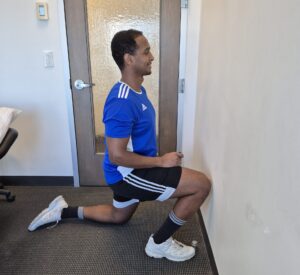
Knee to wall stretch:
Start in a lunge position. Gently glide your knee over your first and second toe. After an ankle sprain you will notice that this movement is more stiff. Gently work on this over the next few weeks to regain the flexibility.
Ankle Sprain: Frequently Asked Questions
1. What are the early signs of an ankle sprain?
The symptoms of an ankle sprain typically appear shortly after the injury and may include:
- Pain around the ankle, especially when standing or walking
- Swelling around the joint
- Tenderness to touch
- Bruising or discoloration
- Reduced range of motion
- A feeling of instability or weakness in the ankle
The severity of symptoms often depends on the extent of the ligament injury.
2. How can I tell if my ankle is sprained or broken?
A sprain and a fracture can have similar symptoms, making it difficult to tell the difference without a professional assessment.
Signs that may suggest a fracture include:
- Severe pain immediately after the injury
- Significant swelling or deformity
- Inability to bear weight on the affected leg
- Pain directly over a bone rather than the surrounding soft tissue
- A cracking or snapping sensation at the time of injury
If you suspect a fracture, seek medical attention promptly.
3. What is the fastest way to reduce swelling after an ankle sprain?
Early management focuses on controlling pain and swelling.
Helpful strategies include:
- Resting the injured ankle
- Applying ice for short periods throughout the day
- Using compression with an elastic bandage
- Elevating the ankle above heart level when possible
- Avoiding activities that aggravate symptoms
Managing swelling early can help improve comfort and support recovery.
4. Should I walk on a sprained ankle or rest completely?
Complete rest is usually not recommended for extended periods. After the initial phase of injury, gradual and pain-free movement is often beneficial.
General guidelines include:
- Rest during the first 24–48 hours if walking is painful
- Begin gentle movement as tolerated
- Avoid activities that significantly increase pain or swelling
- Progress weight-bearing gradually
A physiotherapist can help determine the appropriate level of activity based on the severity of the sprain.
5. How long does it take for a sprained ankle to heal?
Recovery time varies depending on the severity of the injury.
Typical timelines include:
- Mild sprains: approximately 1–3 weeks
- Moderate sprains: approximately 3–8 weeks
- Severe sprains: several months
Factors such as age, overall health, activity level, and rehabilitation can influence healing time.
6. What exercises help recover from an ankle sprain?
Rehabilitation exercises are important for restoring mobility, strength, and function.
Common exercises include:
- Ankle circles
- Alphabet exercises using the foot
- Calf raises
- Resistance band ankle strengthening
- Heel-to-toe walking
- Balance exercises
Exercises should be progressed gradually based on symptoms and healing.
7. When should I start stretching after an ankle sprain?
Gentle stretching can often begin once acute pain and swelling start to improve.
Common stretches include:
- Calf stretches
- Achilles tendon stretches
- Ankle mobility exercises
Stretching should be comfortable and should not cause significant pain. A physiotherapist can advise on the most appropriate timing for your specific injury.
8. Can physiotherapy help prevent future ankle sprains?
Yes. Physiotherapy plays an important role in reducing the risk of recurrent ankle injuries.
Treatment may focus on:
- Improving ankle strength
- Restoring balance and coordination
- Enhancing joint stability
- Correcting movement patterns
- Developing sport-specific injury prevention strategies
Many recurrent sprains occur because balance and stability are not fully restored after the initial injury.
9. When should I see a physiotherapist for ankle pain or instability?
You may benefit from physiotherapy if you experience:
- Persistent ankle pain
- Repeated ankle sprains
- Ongoing swelling
- Difficulty returning to sports or exercise
- A feeling that the ankle frequently “gives way”
- Reduced mobility or strength
Early intervention may help improve recovery and prevent long-term issues.
10. What are the best balance and strengthening exercises for ankle rehabilitation?
Balance and strengthening exercises are key components of ankle rehabilitation.
Common examples include:
Balance exercises:
- Single-leg standing
- Tandem standing
- Balance board exercises
- Single-leg reaches
Strengthening exercises:
- Calf raises
- Resistance band exercises
- Step-ups
- Heel walks and toe walks
- Single-leg squats (when appropriate)
These exercises help improve ankle stability, reduce reinjury risk, and support a safe return to daily activities and sports.