A shoulder dislocation is a potentially serious injury in which your upper arm bone pops out of the cup-shaped part of your shoulder blade. One of the most common reasons people get dislocated shoulders are due to trauma from direct force along the back of the shoulder. Shoulders are one of the most mobile joints in the body which makes it more vulnerable to shoulder dislocations.

What is it?
The shoulder joint is normally thought of as a ball-and-socket joint. The ball is the round part of the bone that fits into a cup-shaped socket of the shoulder blade. When this upper arm bone is pulled or twisted with heavy force away from the socket, this typically results in a shoulder dislocation. This extreme force literally pops the top of the humerus right out of its socket. The shoulder is one of the most mobile joints in the body making it more susceptible to dislocations.
What are the signs and symptoms?
-
- Swelling, bruising and tenderness
-
- Difficulty moving the shoulder
-
- Inability to bear weight on the arm
-
- Numbness or tingling in the neck or arm
-
- Muscle spasmsn
How is it treated?
Your doctor will ask you to rest your shoulder in a sling for about 2-4 weeks. During a shoulder dislocation the ligaments and tendons in your shoulder are overstretched. Resting in a sling for a number of weeks will allow your ligaments and tendons to recover.
After this period of rest it is time to begin gently stretching and strengthen your shoulder. Your physiotherapist will massage the muscles around your neck and shoulder. Your shoulder will feel quite tight and your shoulder flexibility will be limited after this period of time in the sling. Your physiotherapist will gently stretch your shoulder to help you regain flexibility.
Common home exercises
Wall crawls:
Place your hand on a wall. Walk your fingers up the wall reaching up as high as you feel comfortable. Perform 5-10 reps x 3 sets.
Assist overhead reach:
Clasp your hands together. Use your healthy arm to lift your injured arm up as high as you feel comfortable. Perform 5-10 reps x 3 sets.

Shoulder flexion with band:
Holding onto a band or a water bottle. Keep your elbow straight and lift your arm up in front of you. Lift your arm up to shoulder height and lower your arm down slowly. Perform 8-15 reps x 3 sets.
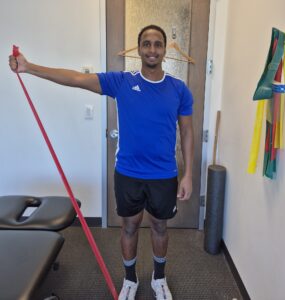
Shoulder scaption with band:
Use a band or a water bottle for resistance for this exercise. Keep your elbow straight and lift your arm up at a 45 degree angle in front of you. Lift your arm up to shoulder height and lower your arm down slowly. Perform 8-15 reps x 3 sets.

Shoulder Dislocation – Frequently Asked Questions
1. What are the first signs of a shoulder dislocation?
The most common early signs of a shoulder dislocation include sudden and severe shoulder pain, visible deformity or the shoulder looking “out of place,” and an inability to move the arm normally. Many people also experience swelling, muscle spasms, weakness, or numbness around the shoulder or arm.
2. What causes a shoulder to dislocate?
A shoulder dislocation typically occurs when a strong force pushes the upper arm bone out of the shoulder socket. Common causes include:
-
Sports injuries (especially contact sports or falls)
-
Falling onto an outstretched arm
-
Car accidents
-
Sudden twisting or pulling forces
Because the shoulder joint is the most mobile joint in the body, it is also more vulnerable to instability and dislocation.
3. Can a dislocated shoulder fix itself?
In some cases, the shoulder may slip back into place on its own shortly after the injury. However, even if this happens, the surrounding muscles, ligaments, or cartilage may still be damaged. It is important to seek medical evaluation to ensure the joint is properly aligned and to prevent future instability. Recurrent dislocation is common if the shoulder musculature is weak which causes the shoulder joint to be unstable. Physiotherapy is critical to strengthen the shoulder musculature in order to prevent a dislocation in the future.
4. How long does it take to recover from a shoulder dislocation?
Recovery time depends on the severity of the injury and whether it is a first-time or recurrent dislocation.
-
Mild cases: 4–6 weeks
-
Moderate injuries: 6–12 weeks
-
More severe cases or surgery: several months
Rehabilitation exercises and physiotherapy can help restore strength, stability, and range of motion.
5. When should you see a doctor for a dislocated shoulder?
You should seek medical attention immediately if you suspect a shoulder dislocation. A doctor should evaluate the injury if you experience:
-
Severe pain
-
A visible shoulder deformity
-
Inability to move your arm
-
Numbness or tingling in the arm or hand
-
Significant swelling
Prompt treatment helps reduce the risk of nerve damage and long-term instability.
6. Is it safe to pop a dislocated shoulder back in yourself?
No, it is not recommended to attempt to relocate a dislocated shoulder yourself. Improper techniques can cause further damage to nerves, blood vessels, or surrounding tissues. A trained healthcare professional should perform the reduction safely and may use imaging to confirm proper alignment.
7. What exercises help after a shoulder dislocation?
Once the shoulder is stable and cleared by a healthcare provider, rehabilitation exercises can help restore strength and control. Helpful exercises often include:
-
Gentle range-of-motion exercises
-
Shoulder blade (scapular) stabilization exercises
-
Rotator cuff strengthening
-
Resistance band exercises
-
Gradual return to functional movements
Refer to the exercises above for example of helpful physiotherapy exercises.
8. Which exercises should you avoid after a shoulder dislocation?
During recovery, certain movements may increase the risk of re-injury. These may include:
-
Overhead lifting too early
-
Heavy bench presses
-
Sudden throwing motions
-
Deep push-ups or dips
-
Contact sports before proper rehabilitation
Avoiding high-risk movements early in recovery helps protect healing tissues.
9. Can a shoulder dislocation happen again?
Yes, once the shoulder has dislocated, the risk of recurrence increases—especially in younger individuals and athletes. Weakness in the rotator cuff muscles or damage to stabilizing ligaments can make the joint more prone to future dislocations. Strengthening and stability training with a physiotherapist can significantly reduce this risk.
10. How do you reduce pain after a shoulder dislocation?
Pain management after a shoulder dislocation may include:
-
Resting the shoulder and using a sling if recommended
-
Applying ice for 15–20 minutes at a time
-
Taking anti-inflammatory medication if advised by a doctor
-
Gentle movement as guided by a healthcare professional
-
Physiotherapy to restore normal movement and strength
Proper rehabilitation is key to reducing pain and preventing long-term shoulder problems.