
Back pain is one of the most common health complaints. It doesn’t just hurt—it disrupts daily life. It can make sitting at your desk unbearable, keep you from enjoying hobbies, interfere with exercise, and even rob you of a good night’s sleep. Because the spine supports nearly every movement, pain in this area can feel overwhelming and constant. One common culprit behind chronic back pain is lumbar degenerative disc disease (DDD), which is a natural age-related condition that can cause persistent discomfort. The good news is that with the right understanding, treatment options, and targeted exercises, you can take back control from back pain.

What is it?
Lumbar degenerative disc disease (DDD) is part of the natural aging process. It can occur anywhere in the spine, but it is most common in the cervical (neck) and lumbar spine (lower back). Degenerative disc disease refers to the gradual breakdown of the intervertebral discs—the soft cushions between the bones (vertebrae) of the spine. They also help maintain proper spacing between the vertebrae, which protects the nerves branching out from the spinal cord. These discs reside between each vertebrae and normally act as shock absorbers, allowing flexibility and motion while protecting the spinal column.
Nearly everyone experiences some degree of disc degeneration as they get older, but not everyone develops painful symptoms. As discs wear down, they may lose their ability to cushion the spine, leading to pain and stiffness. For some, the changes are mild and go unnoticed, while for others, degeneration can lead to chronic pain, stiffness, or nerve irritation.
What are the signs and symptoms?
Degenerative disc disease symptoms vary depending on the affected spinal region, but they typically follow a mechanical pattern. For the purposes of this post we will focus on lower back symptoms which may include:
- Aggravating factors: Positions and movements that increase disc pressure including sitting, lifting, twisting or forward bending tend.
- Easing Factors: Lying down, standing, walking or changing positions since these positions reduce pressure on the discs.
- Episodes of flare-ups: pain may come and go rather than being constant, sometimes lasting for days or weeks.
- Pain pattern: Chronic low back pain that feels dull, aching, or stiff. Pain radiating into the buttocks, hips, or thighs (often mistaken for muscle strain).
Sciatica: sharp, shooting pain that travels down one or both legs, caused by irritation of the sciatic nerve. - Numbness and tingling: Feelings of numbness, tingling, burning and/or pins and needles may be experienced in the legs, hands or toes.
- Weakness: Muscular weakness in the legs may occur if there is compression of the nerve. This may also lead to feelings of instability in the lower back, especially when transitioning from sitting to standing.
If you are experiencing lumbar DDD, you may not experience all of these symptoms and severity varies on a case by case basis.
How is it treated?
Most people with DDD improve with conservative (non-surgical) treatment. Physiotherapy can help to resolve symptoms through a combination of treatment techniques and precise exercise prescription tailored to your needs. This will be based on a comprehensive assessment of your range of motion, strength, and medical history among other factors.
Manual stretching and massaging of the muscles of the lower back and hips are typically included in treating acute cases of degenerative disc disease. Acupuncture and dry needling is also another effective treatment at reducing lower back pain and promote healing. Addressing posture and discussing proper ergonomics will be key in the long term management of this condition. In severe cases where conservative treatment does not resolve symptoms, spinal surgeries or epidural steroid injections may be implemented by a physician if indicated.
Common home exercises
Regular exercise can help strengthen core muscles, support the spine, and reduce pain. Below are some common exercises prescribed for DDD.
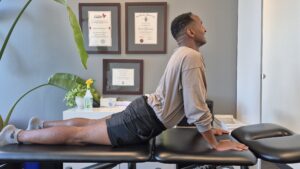
Cobra
- Lie face down on a mat with your legs straight and feet hip-width apart.
- Place your palms flat on the floor beside your shoulders, elbows bent and tucked close to your body.
- Inhale, and gently press your palms into the floor.
- Slowly lift your head, chest, and upper abdomen off the mat.
- Keep your elbows slightly bent and shoulders relaxed (do not shrug).
- Repeat 10–15 times. Complete this exercise every 1-2 hours.
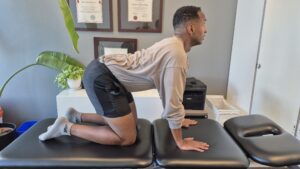
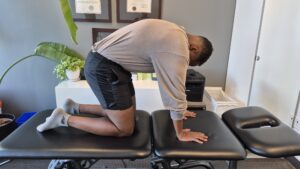
Cat-Camel Stretch
- Start on your hands and knees (crawling position). Make sure the arms and knees are stacked under the shoulders and hips respectively.
- On an inhale, drop your belly, arch your back, lift your sit bones, and gaze upward into the “camel-position”.
- On an exhale, round your spine, tuck your chin toward your chest, and pull your belly button to your spine, creating a “cat-like” rounded back
- Repeat 10–15 times slowly. Complete this exercise every 1-2 hours.
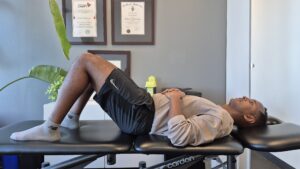
Bridging Exercise
- Lie on your back with knees bent, feet flat.
- Tuck your hips underneath you, flatten your back against the ground, and squeeze the glutes.
- Lift hips until shoulders, hips, and knees form a straight line.
- Hold for 5 seconds while maintaining normal breathing. Lower slowly and repeat.
- Frequency: Perform 10-15 repetitions for 1 set. Complete 3 sets per day.

Dead Bug
Learn how to perform a Dead Bug here.
Frequently Asked Questions (FAQ)
1. What causes lumbar degenerative disc disease in the lower back?
Lumbar degenerative disc disease occurs when the intervertebral discs in your lower back begin to break down over time.
Main causes include:
- Aging: Natural wear and tear reduces disc hydration and elasticity.
- Repetitive stress: Bending, lifting, or twisting motions over years.
- Injury or trauma: A sudden strain can speed up disc degeneration.
- Genetics: Some people are predisposed to faster disc wear.
- Poor posture and weak core muscles: These increase pressure on the lumbar discs.
2. Can degenerative disc disease heal or improve without surgery?
Yes — while discs don’t “heal” back to their original state, most people improve without surgery.
Non-surgical treatments that can help include:
- Physiotherapy: Strengthening core and stabilizing muscles.
- Exercise and posture correction.
- Anti-inflammatory treatments: Heat, ice, or medication.
- Epidural injections (if needed).
With consistent care, pain and stiffness often decrease significantly over time.
3. What are the best exercises for lumbar degenerative disc disease?
Low-impact and core-stabilizing exercises are ideal. Refer to the exercises listed above.
4. Is walking good for lower back disc degeneration?
Yes — walking is one of the best activities for lumbar DDD since walking:
- Promotes blood flow to the discs
- Strengthens supporting muscles
- Improves posture and flexibility
- Reduces stiffness without high impact
Aim for 20–30 minutes daily, on level ground, with proper footwear.
5. What should I avoid if I have degenerative disc disease?
Avoid activities that stress or compress the spine:
- Heavy lifting or twisting
- High-impact sports (running, jumping)
- Sitting for long periods
- Poor posture (especially slouching or leaning forward)
- Smoking — it reduces disc nutrition and healing
6. When should I see a doctor for degenerative disc disease?
See a healthcare provider if you experience:
- Persistent pain lasting more than a few weeks
- Numbness, tingling, or weakness in your legs
- Pain that radiates down one leg (sciatica)
- Loss of bladder or bowel control (emergency)
Early diagnosis and physiotherapy can prevent worsening.
7. How long does recovery from lumbar degenerative disc disease take?
Recovery time varies.
- Mild cases: Improvement in 4–6 weeks with proper exercise and posture care.
- Moderate to chronic cases: May take 3–6 months for noticeable improvement.
- Ongoing maintenance (stretching, core strengthening, ergonomics) helps manage symptoms long term.