You have been feeling pain along the outside of your hip for a few weeks when you have been walking and climbing stairs. The pain gets better when you are sitting and returns quickly once you are moving around on your feet. This injury could be due to a condition called trochanteric bursitis. Physiotherapy treatment for this injury is very effective. Let’s learn more about how to treat trochanteric bursitis.
What is it?
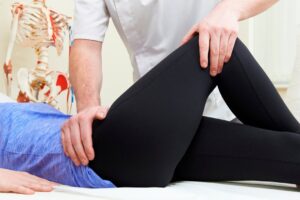
Trochanteric bursitis — now more accurately called greater trochanteric pain syndrome (GTPS) — is a common cause of outer hip pain. The greater trochanter is part of the femur (thigh bone). The trochanteric bursa sits between the greater trochanter and the gluteal tendons (mainly gluteus medius and minimus). Its job is to reduce friction during hip movement. Trochanteric bursitis occurs when there is too much friction on the bursa and it becomes irritated or inflamed.
Trochanteric bursitis or GTPS often develops from:
- Overuse or repetitive friction (e.g., running, cycling, climbing stairs)
- Muscle weakness or tightness (especially in the gluteal or IT band muscles)
- Direct trauma to the outer hip (e.g., a fall or bump)
- Poor posture or gait mechanics (like limping or leg length discrepancy)
- Inflammatory conditions such as rheumatoid arthritis
- Post-surgical irritation (e.g., after hip replacement)
What are the signs and symptoms?
- Pain on the outside of the hip or thigh, often over the bony point of the hip
- Pain that worsens with walking, climbing stairs, lying on the affected side, or standing up after sitting
- Tenderness to touch over the greater trochanter
- Occasionally, pain may radiate down the outer thigh (but not below the knee)
How is it treated?
Often times tension in the gluteus medius, minimus, tensor fascia latae, and IT band can cause compression and friction to irritate the trochanteric bursae. There are a number of treatment options that can release the tension in these muscles. Massage, active release treatment, and stretching are manual therapy techniques that your physiotherapist will use to treat these tight muscles. Tight muscular knots build up along the gluteus medius, gluteus minimus, and tensor fascia latae due to overuse. Dry needling is a form of acupuncture which can precisely release these stubborn muscular knots. If overuse due to work and or exercise is a cause of your trochanteric bursitis your physiotherapist will work with you to create a plan on how to get the rest you need. Adjusting your work ergonomics or training load during exercise can greatly help with your overall recovery.
Common Home Exercises
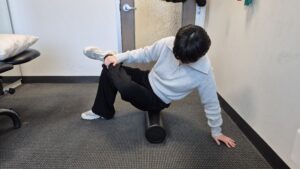
Foam rolling gluteus medius:
-
Sit on the foam roller
-
Sit on the roller with your knees bent and feet flat on the floor.
-
Place your hands behind you for balance.
-
-
Shift to one side
-
Lean your weight onto one buttock — the side you want to target (e.g., left glute).
-
Cross your left ankle over your right knee (a figure-4 position).
-
This opens up the gluteal area and exposes the gluteus medius.
-
-
Locate the gluteus medius
-
It’s found on the upper outer quadrant of your buttock, just below the top of your hip bone (the iliac crest).
-
You should avoid rolling directly on the bony ridge.
-
-
Slow rolling
-
Slowly roll back and forth (up and down about 2–4 inches) over that upper outer area.
-
Move slowly — about 1 inch per second.
-
Spend about 30–60 seconds on tender or tight spots.
-
-
Pause and hold
-
If you find a sore spot (trigger point), pause and hold pressure for 20–30 seconds, breathing deeply.
-
Optionally, gently rock side-to-side over the spot for added release.
-
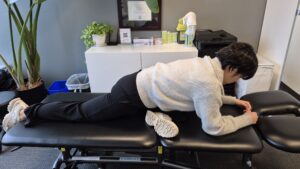
Pigeon pose (gluteus medius stretch)
-
Begin in a plank or all-fours position.
-
Bring your right knee forward and place it behind your right wrist.
-
Slide your left leg straight back behind you.
-
Keep your hips square and lean your torso forward over your right leg.
-
You should feel a strong stretch in your right glute and outer hip.
-
Hold for 20–45 seconds and repeat for 3 sets.
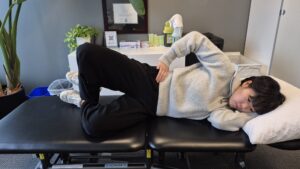
Side lying clam shells
-
Lie on your side with hips and shoulders stacked vertically.
-
Bend your knees to about 90 degrees, keeping your feet in line with your spine.
-
Rest your head on your lower arm, and place your top hand on your hip for stability.
-
Keep your feet together and slowly lift your top knee upward — like a clamshell opening.
-
Lift until you feel your glutes contract (do not twist your hips or roll backward).
-
Pause for 1–2 seconds at the top of the movement.
-
Slowly lower your knee back down to the starting position.
- Perform 12-20 repetitions for 3 sets.
Banded Crab walk
learn how to perform the crab walk here.
Trochanteric Bursitis – FAQ
1. Why does my hip hurt more when I walk upstairs but feel fine when I’m seated?
Trochanteric bursitis causes pain when the bursa (a small fluid-filled sac near the hip) is irritated, which usually happens during weight-bearing activities like walking, climbing stairs, or standing. Sitting often relieves pressure on the bursa, so the pain decreases.
2. Is trochanteric bursitis just “hip bursitis,” or is it something more?
Trochanteric bursitis is a type of hip bursitis affecting the bursa on the outside of the hip near the greater trochanter. While “hip bursitis” can refer to several bursae around the hip, trochanteric bursitis specifically involves this lateral hip bursa.
3. Why does foam rolling sometimes feel great and terrible for my hip?
Foam rolling can help release tight muscles around the hip and glutes, reducing pressure on the bursa. However, if done incorrectly or too aggressively, it can irritate the bursa and temporarily worsen pain. Gentle, controlled rolling is usually most effective. To learn more about the correct muscles to foam roll consult a physiotherapist.
4. Do I need a cortisone shot to fix trochanteric bursitis?
Not always. Many cases improve with conservative care such as rest, activity modification, physiotherapy, and anti-inflammatory strategies. Cortisone injections can provide relief for persistent pain, but they are usually considered after conservative measures have been tried.
5. Does trochanteric bursitis only happen to athletes?
No. While athletes who run, jump, or cycle may be more prone, trochanteric bursitis can affect anyone. Risk factors include:
-
Prolonged standing or walking
-
Muscle imbalances around the hip
-
Poor biomechanics
-
Hip or knee injuries
-
Age-related changes
6. Can strengthening my glutes speed up my healing?
Yes. Weak glute muscles can increase stress on the lateral hip and bursa. Strengthening the glutes helps stabilize the hip, reduces irritation of the bursa, and can speed up recovery. Common exercises involve clam shells and standing hip fire hydrants.
7. Should I ice my hip and for how long?
Icing can help reduce inflammation and pain. Apply ice for 10–15 minutes at a time, several times a day, especially after activities that aggravate your hip. Always place a cloth between the ice and skin to prevent irritation.
8. When should I see physiotherapy if home care isn’t helping?
If symptoms persist for more than 1–2 weeks despite home care (rest, stretching, icing), or if pain is limiting daily activities, seeing a physiotherapist is recommended. Physiotherapy can:
-
Identify underlying muscle imbalances or movement issues
-
Provide targeted exercises to relieve pressure on the bursa
- Perform manual therapy treatments such as massage to release tight muscles in the hip and back
-
Improve strength, flexibility, and movement patterns to prevent recurrence