Medial Collateral Ligament (MCL) tears are one of the most common knee injuries, especially among athletes and active individuals. Whether the injury comes from a sudden twist, a direct hit to the outside of the knee, or simply an awkward step, an MCL tear can make everyday movements feel painful and unstable. Understanding what the MCL does, how these injuries happen, and what recovery looks like can help you make informed decisions and feel more confident throughout the healing process.

What is it?
A medial collateral ligament (MCL) tear is a common knee injury that affects one of the major ligaments responsible for stabilizing your knee. The MCL sits along the inner side of your knee, connecting your thigh bone (femur) to your shin bone (tibia). Its main job is to prevent your knee from bending inward and to keep the joint steady during movement.
MCL tears typically occur when the knee is forced inward, which can happen in several everyday or athletic situations. A sudden hit to the outside of the knee—common in contact sports like soccer, basketball, and football—can overstress the ligament. Twisting or pivoting movements may also place excessive strain on the inner knee, especially during quick changes of direction. Even simple accidents such as slipping or landing awkwardly can cause the knee to buckle inward. In some cases, overstretching during physical activity is enough to injure the ligament. These types of forces can result in anything from a mild strain to a complete tear of the MCL.
What are the signs and symptoms?
An MCL tear often causes:
-
Pain on the inner side of the knee
-
Swelling or stiffness
-
Tenderness when touching the inside of the joint
-
A feeling of instability or “giving way,” especially with Grade II–III injuries
-
Difficulty bending or straightening the knee fully
How is it treated?
Treatment after an initial MCL tear will focus on protecting the knee. Your physiotherapist will often recommend a hinge brace for you to wear to provide stability and protect the knee. After an MCL tear, your knee will be quite stiff and your knee range of motion will be limited making sitting and walking difficult. To improve your knee flexibility, your physiotherapist will massage and stretch your knee. Exercises will be prescribe to strengthen the glut and quadriceps muscle to restore stability in your knee. These muscles are critical in supporting your knee in simple day to day activities such as walking and standing and in athletic movements such as running and jumping. Although you will take short break in terms of sports and training your physiotherapist will work with you to determine a plan of when you can safely return back to sports.
Common home exercises
Quad Setting
-
Position Yourself
Lie on your back or sit with your injured leg extended straight out in front of you. Keep the leg relaxed and fully supported on the floor or a firm bed. -
Engage Your Quadriceps
Tighten the muscles on the front of your thigh by gently pressing the back of your knee downward into the surface. You should feel your kneecap glide slightly upward as the muscle contracts. -
Hold the Contraction
Maintain the squeeze for 5–10 seconds, keeping your leg completely still. Avoid lifting your heel or bending your knee. -
Relax and Repeat
Release the tension and allow the muscle to fully relax.
Repeat 10–15 times, aiming for 2–3 sets.
Standing Hip Fire Hydrant
-
Starting Position
Stand tall with your feet hip-width apart. Engage your core and keep a soft bend in both knees. If needed, place one hand on a wall or sturdy surface for balance. -
Shift Your Weight
Gently shift your weight onto your supporting leg, keeping your pelvis level and your torso upright. -
Lift the Working Leg
Lift the opposite leg out to the side in a controlled “open the gate” motion—similar to a dog lifting its leg on a hydrant. -
Control the Movement
Lift only as far as you can without rotating your hips or trunk. The movement should come from your hip, not your lower back. -
Lower Slowly
Bring your leg back to the starting position with control. Avoid dropping it quickly. -
Repeat
Perform 10–15 repetitions, then switch sides. Complete 2–3 sets per leg.
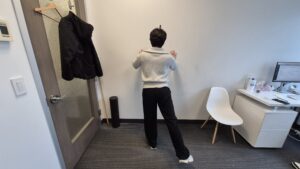
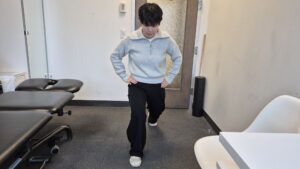
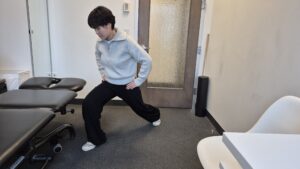
Clock Lunges
-
Start Position:
Stand tall with your feet hip-width apart, core engaged, and hands on your hips or clasped in front of your chest for balance. Imagine you’re standing in the center of a clock. -
Step to 12 o’clock (Forward Lunge):
Step your right foot straight forward to the 12 o’clock position. Lower into a lunge, keeping your front knee aligned with your toes and your chest upright. Push through your front heel to return to the center. -
Step to 3 o’clock (Side Lunge):
Step your right foot directly out to the side toward the 3 o’clock position. Sit your hips back and bend your right knee while keeping your left leg straight. Press through the right foot to come back to the starting position. -
Step to 5 o’clock (Reverse-Diagonal Lunge):
Step your right foot diagonally back toward about the 5 o’clock position. Lower into a lunge with your chest lifted and your weight centered. Push through your left leg to return to the middle. -
Repeat with the Left Leg:
Perform the same sequence stepping with your left foot—forward to 12 o’clock, out to 9 o’clock, then diagonally back toward 7 o’clock. -
Complete the Cycle:
Continue alternating legs for the desired number of cycles, focusing on smooth movement, good posture, and control with every step.