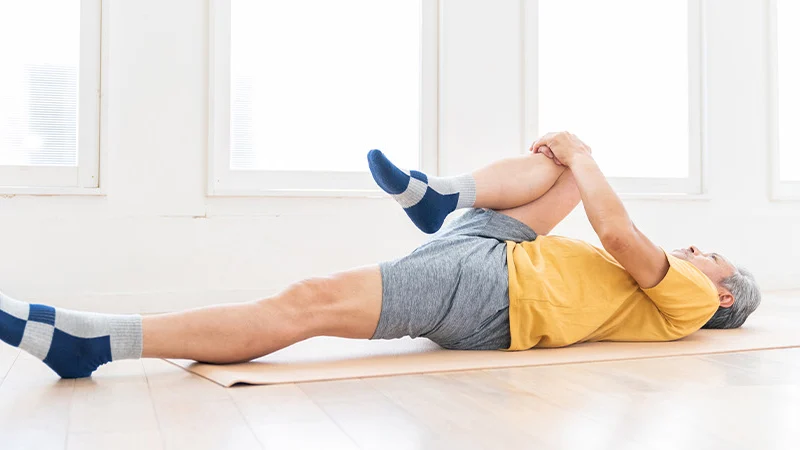
A meniscus injury in the knee can often happen when playing a sport during a sudden twisting movement or could be damaged due to wear and tear over time. The knee pain can be debilitating affecting your ability to walk, stand, or even at rest. Fortunately most patients make a full recovery from a meniscus injury and is able to return back to the activity or sport of choice. Lets learn more about the meniscus and the process of recovery.

What is it?
A meniscus injury refers to damage to the meniscus, which is a C-shaped piece of cartilage in the knee that acts as a cushion between the thighbone (femur) and the shinbone (tibia). Each knee has two menisci. A medial meniscus (inner side of the knee) and a lateral meniscus (outer side of the knee).
The meniscus plays a crucial role in knee function by providing:
- Shock Absorption – It cushions the impact between the femur (thighbone) and tibia (shinbone), reducing stress on the knee joint.
- Joint Stability – It helps keep the knee stable by evenly distributing body weight across the joint.
- Load Distribution – It prevents excessive pressure on any one part of the knee, reducing the risk of cartilage wear and osteoarthritis.
- Lubrication & Nutrition – It assists in the distribution of synovial fluid, keeping the joint lubricated and nourished.
- Facilitates Smooth Movement – The meniscus allows for smooth knee motion, preventing bone-on-bone contact.
Common causes of meniscus injuries include:
- Twisting or rotating the knee forcefully, especially while the foot is planted
- Sudden stops and pivots, common in sports like soccer, basketball, and football
- Deep squatting or heavy lifting
- Degenerative changes due to aging, leading to wear and tear
Sometimes when the medial meniscus is injured the medial collateral ligament (MCL) and the anterior cruciate ligament (ACL) can also be injured at the same time. This is known as a “dangerous triad”.
What are the signs and symptoms?
The signs and symptoms of a meniscus injury depend on the severity of the tear but commonly include:
- Pain – Pain is usually felt on the inner (medial meniscus) or outer (lateral meniscus) side of the knee. Pain worsens with twisting, squatting, or weight-bearing activities.
- Swelling and stiffness – Swelling may develop immediately or within hours after the injury. The knee may feel stiff and difficult to move.
- Popping Sensation – Some people report hearing or feeling a “pop” at the time of injury.
- Locking or Catching – The knee may lock or feel like it gets stuck in a certain position due to a torn piece of cartilage interfering with movement.
- Difficulty Bending and Straightening the Knee – You may feel resistance when trying to fully extend or bend the knee.
- Knee Instability or Weakness – The knee may feel unstable, like it might “give out”, especially when walking or pivoting.
- Limited Range of Motion – Difficulty moving the knee through its full range due to pain or mechanical blockage.
How is it treated?
Your physiotherapist will complete a thorough physical exam which involves a number of tests to diagnosis your injury. After a meniscus injury, your body may try to protect the meniscus by clenching the muscles around the knee. This can cause additional stiffness and pain in the knee when you are walking, standing, or sitting. Your physiotherapist will massage and gently stretch the muscles around your knee and hip to improve your flexibility and decrease pain. Massaging the meniscus will also help improve blood flow to the area to promote healing. Your physiotherapist can also use acupuncture to decrease pain and increase blood flow to your knee. If you are experiencing a lot of pain and instability a hinge knee brace may also be recommended. A progressive exercise program will be designed by your physiotherapist and this will be critical to helping you improve your flexibility and strength so you can make a full recovery.
Common home exercises
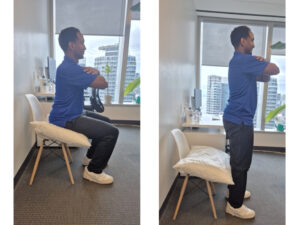
Sit to Stand Squat on Pillows
This exercise is excellent at strengthen your quadriceps and gluts. It is also a very practical movement that you will need in every day activities. Moving from a sitting to standing position from a regular chair height can be painful. By placing a pillow on the chair you will not have to squat down as low which can make this exercise more comfortable. As your knee improves you can progress the exercise by removing the pillow so you have to squat lower.
-
Setup:
- Place a pillow on a chair. Sit on the pillow with your feet about hip-width apart.
- Keep your knees at a 90-degree angle and your feet flat on the floor.
- Sit tall with your chest up and shoulders back.
-
Engage Core & Push Through Heels:
- Tighten your core and press through your heels as you start to stand.
- Keep your back straight and avoid leaning too far forward.
- Use your legs and glutes to lift yourself up.
-
Stand Up Fully:
- Once standing, squeeze your glutes and fully extend your hips.
- Keep your knees slightly soft (don’t lock them).
-
Control the Lowering Phase:
- Slowly lower yourself back down by bending your knees and pushing your hips back.
- Try to control the descent rather than just dropping into the chair.
- Lightly touch the chair before repeating.
Single Legged Balance
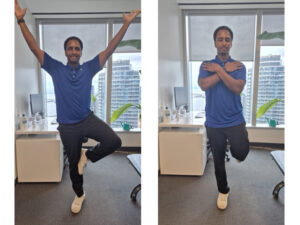
A single-legged balance exercise is great for improving stability, coordination, and lower body strength. Here’s how to perform it correctly:
-
Starting Position
- Stand upright with feet hip-width apart.
- Keep your core engaged and your gaze fixed on a point in front of you for stability.
-
Lift One Leg
- Slowly lift one foot off the ground, bending the knee to about 90 degrees.
- Hold the position while keeping your body upright and balanced.
- Keep your arms at your sides, out to the sides, or on your hips for stability.
-
Hold & Balance
- Maintain balance for 20–30 seconds on one leg.
- Try to avoid excessive swaying or putting your foot down.
-
Switch Legs
- Lower your foot back to the ground and repeat the movement on the other leg.
- Perform 2–3 sets per leg.
Progressions for More Challenge
- Close your eyes to remove visual cues.
- Stand on an unstable surface (e.g., foam pad, Bosu ball).
- Move your lifted leg (extend forward, backward, or sideways).
- Perform arm movements (e.g., reach in different directions).
Jump Squats
Jump squats are a great way to build explosive strength, improve athletic performance, and increase lower-body power. This exercise is reserved to the end of the rehab process to help patients return back to athletic activities.
1. Starting Position
- Stand with your feet shoulder-width apart.
- Keep your chest up, core engaged, and shoulders back.
- Place your hands in front of you or by your sides for balance.
2. Perform the Squat
- Lower into a squat by pushing your hips back and down, keeping your knees aligned with your toes.
- Go down until your thighs are parallel to the floor (or slightly lower if comfortable).
3. Explosive Jump
- Push forcefully through your heels and explode upward into a jump.
- Extend your legs fully and keep your core tight.
- Swing your arms up for momentum if needed.
4. Land Softly
- Land gently on the balls of your feet, then shift weight back to your heels.
- Absorb the impact by bending your knees and lowering back into a squat position.
- Immediately go into the next rep.

Meniscus Injuries: Frequently Asked Questions (FAQ)
Meniscus injuries are among the most common knee problems, affecting people of all ages—from athletes to individuals simply twisting their knee during daily activities. This FAQ breaks down what you need to know about symptoms, treatment, rehab, and recovery.
1. What is a meniscus and what happens in a meniscus injury?
The meniscus is a C-shaped piece of cartilage inside the knee that acts as a shock absorber, stabilizer, and protector of the joint surfaces. Each knee has two menisci: a medial (inside) and lateral (outside) meniscus.
A meniscus injury occurs when this cartilage tears due to:
-
A sudden twist, pivot, or deep squat
-
Trauma during sports
-
Gradual wear and tear from aging or repetitive use
Depending on the type of tear, the meniscus may lose its ability to cushion the knee, leading to pain, swelling, and restricted motion.
2. What are the typical signs and symptoms of a meniscus injury?
Common symptoms include:
-
Pain along the joint line (inside or outside of the knee)
-
Swelling that develops within hours or the next day
-
Clicking, catching, or a feeling of the knee “locking”
-
Difficulty straightening or bending the knee fully
-
A sensation of instability or the knee giving way
-
Stiffness, especially after inactivity
Symptoms may vary depending on the severity and location of the tear.
3. What are the treatment options for a meniscus injury?
Treatment depends on the type, size, and location of the tear, as well as your activity level. Options include:
Conservative (non-surgical) treatment
-
Rest and activity modification
-
Ice and compression
-
Anti-inflammatory medication
-
Physiotherapy to restore motion, strength, and a rehab plan on how to return back to daily function and sports
Many small or degenerative tears respond well to conservative care.
Surgical treatment
If symptoms persist, surgery may be considered:
-
Meniscus repair: The tear is stitched back together (best in younger patients or in tears with good blood supply).
-
Meniscectomy: The damaged portion is trimmed away when repair isn’t possible.
The choice depends on the tear’s location, shape, and age.
4. What kinds of home exercises are recommended during rehabilitation?
Refer to the common home exercises listed above.
5. How long is the rehabilitation process for a meniscus injury?
Recovery time varies:
Non-surgical tears:
-
4–6 weeks for most daily activities and sport
-
Degenerative tears may require ongoing strengthening
After meniscus repair surgery:
-
3–6 months for full recovery
-
Weight-bearing often restricted at first
-
Return to sport typically around 4–6 months
After partial meniscectomy:
-
2–6 weeks for daily activities
-
6–10 weeks for full activity
Healing time depends on tear severity, age, and overall knee health.
6. When is surgery likely to be needed for a meniscus injury?
Surgery is more likely when:
-
The knee locks or cannot fully straighten
-
There is persistent pain despite physiotherapy
-
The tear is in the “red zone” (area with good blood supply) and repairable
-
The tear is large, displaced, or causing mechanical symptoms
-
The patient is young and active with a traumatic tear
Degenerative tears in older adults often improve without surgery.
7. What factors influence recovery from a meniscus injury?
Recovery depends on several factors, such as:
-
Type, size, and location of the tear
-
Age and activity level
-
Whether surgery is required
-
Strength of surrounding muscles (quadriceps, hamstrings, glutes)
-
Adherence to physiotherapy and home exercises
-
If other injuries are present (ACL tears, arthritis, etc.)
-
Overall knee alignment and biomechanics
A well-structured rehab plan significantly improves outcomes.