You play tennis on a weekly basis and recently started noticing shoulder pain during your forehand. A few more weeks go by and you now start noticing shoulder pain when overhead reaching, pushing open a heavy door, and sleeping on your side. Shoulder pain can be pretty debilitating and annoying. Shoulder bursitis and shoulder tendonitis are two of the most common shoulder conditions. Let’s take a look at what they are and how physiotherapy can fix the issue.

What is shoulder bursitis?
Shoulder bursitis refers to the inflammation of the bursa in the shoulder joint. A bursa is a small, fluid-filled sac that helps reduce friction and allows smooth movement between bones, tendons, and muscles. When this bursa becomes irritated or inflamed, it can cause pain, swelling, and limited range of motion in the shoulder.
Common causes of shoulder bursitis include:
- Overuse or repetitive movements: Activities involving repetitive overhead motions (such as painting, lifting weights, throwing sports) can strain the shoulder and lead to bursitis.
- Trauma or injury: A direct blow to the shoulder or a fall can cause inflammation of the bursa.
- Age-related changes: As people age, the bursa can become more susceptible to inflammation and irritation.
- Other shoulder conditions: Conditions like rotator cuff tears, arthritis, or tendonitis can contribute to bursitis.
Symptoms of shoulder bursitis may include:
- Pain: especially when reaching overhead or moving the arm. Pain that worsens at night, especially when lying on the affected shoulder.
- Swelling: The affected area may be swollen or feel tender to the touch.
- Stiffness: Limited range of motion in the shoulder joint.
What is shoulder tendonitis?
Shoulder tendonitis, also known as tendinitis, is a condition characterized by inflammation, irritation, or degeneration of the tendons in the shoulder. Tendons are tough, flexible bands of tissue that connect muscles to bones, enabling movement of the joints.
In the shoulder, tendonitis often affects the tendons of the rotator cuff or the biceps tendon. The rotator cuff is a group of muscles and tendons that surround the shoulder joint, providing stability and allowing a wide range of motion. When these tendons become inflamed or irritated, it canresult in shoulder tendonitis.
Common causes of shoulder tendonitis:
- Overuse or Repetitive Movements: Continuous overhead arm motions, such as those involved in sports like tennis, swimming, or baseball, or work activities that require repetitive lifting or reaching overhead, can strain the shoulder tendons and lead to tendonitis.
- Injury or Trauma: A sudden injury, such as a fall or direct impact to the shoulder, can cause tendon inflammation.
- Age-related Changes: Tendons can degenerate and become less flexible with age, making them more prone to injury and inflammation.
Symptoms of shoulder tendonitis may include:
- Pain: Often a dull ache in the shoulder that worsens with movement, especially when lifting the arm.
- Swelling: The affected area may be swollen or feel tender to the touch.
- Stiffness: Limited range of motion in the shoulder joint, making it difficult to raise the arm overhead.
- Weakness: Difficulty performing activities that involve the affected shoulder due to weakness in the muscles or pain.
How is it treated?
Treatment for both shoulder bursitis and tendonitis are very similar. Treatment for both conditions will involve manual therapy, exercises, and taking a break from aggravating activities. If weight training is aggravating your shoulder your physiotherapist may ask you to take a break from training particular muscle groups that would aggravate the shoulder issue. Commonly pushing and overhead movements would aggravate the shoulder. Your physiotherapist may ask you to take a few weeks off of doing shoulderand chest exercises, however you may be able to continue bicep, back, and tricep exercises. Your physiotherapist will discuss other activities that you can modify temporarily so your shoulder can get some much needed rest during your rehab.
Manual therapy, which means “hand on” treatment, will focus on stretching and massaging muscles in the front and back of the shoulder. Manual therapy will release tension in the front of the shoulder that includes the pec major, subscapularis, and latissimus dorsi. Muscles in the back of the shoulder such as the infraspinatus, teres major and minor will also be massaged by your physiotherapist to overall improve the flexibility of your shoulder so you can move freely again. Traditional acupuncture and dry needling is also very effective at relieving muscle tension. Your physiotherapist can discuss how acupuncture works and if you are a good candidate for acupuncture.
Common home exercises:
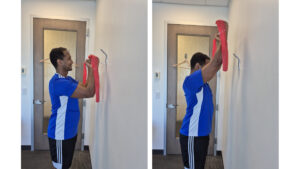
Isometric External Rotation Wall Slide:
The isometric external rotation wall slide is an exercise used to strengthen the rotator cuff muscles and improve shoulder stability. It primarily targets the external rotators of the shoulder, which are essential for maintaining proper shoulder function and preventing injuries.
Here’s how to perform the isometric external rotation wall slide:
Setup: Stand facing a wall and your feet should be about shoulder-width apart. Hold either end of a resistance band with your elbow bent and your forearm touching the wall.
Execution: Pull the bend apart with your hands by externally rotating your shoulder. Slide your forearm up and down the wall while maintaining shoulder external rotation. Repeat for 10-15 repetitions for 3-4 sets.
90/90 External Rotation to Overhead Press:
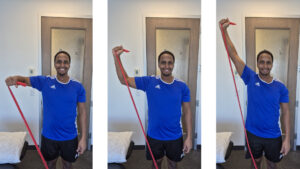
The 90/90 external rotation to overhead press is an exercise that combines two movements to strengthen the shoulder muscles.
Here are the steps to perform the 90/90 external rotation to overhead press:
Set up: Stand with feet shoulder width apart. Hold onto a band. With your elbows bent to 90 degrees abduct your shoulder to 90 degrees.
Execution: Externally rotate your shoulder to 90 degrees so your forearm is facing forward to complete the first movement. Punch your hand toward the ceiling to complete the 2nd movement. Slowly lower your hand and internally rotate your shoulder to return back to the starting position. Repeat for 10-15 repetitions for 3-4 sets.
Shoulder Bursitis vs. Tendonitis: Frequently Asked Questions
1. What is shoulder bursitis versus shoulder tendonitis, and how are they different?
Shoulder bursitis is inflammation of the bursa—small fluid-filled sacs that reduce friction between tendons and bones.
Shoulder tendonitis is inflammation or irritation of a tendon, most commonly the rotator cuff tendons.
While both cause pain with shoulder movement, bursitis typically involves irritation from friction or compression, while tendonitis is related more to tendon overload or degeneration.
2. What early signs or symptoms should make me suspect bursitis or tendonitis in the shoulder?
Common early symptoms include:
-
A dull ache or sharp pain when raising the arm
-
Pain lying on the affected side
-
Weakness or fatigue in the shoulder
-
Discomfort during overhead activities
-
Tenderness at the front or side of the shoulder
Symptoms that worsen gradually—especially after repetitive activity—often point to bursitis or tendonitis.
3. What are the common causes of shoulder bursitis and tendonitis (e.g., overuse, trauma, age)?
These conditions often develop due to:
-
Repetitive overhead activity (lifting, throwing, swimming, trades work)
-
Overuse from gym training without adequate recovery
-
Poor posture or muscle imbalances
-
Trauma, such as falling on the shoulder
-
Age-related changes, which reduce tendon elasticity and bursa resilience
-
Weak rotator cuff or scapular muscles, increasing stress on the shoulder structures
4. How can I distinguish bursitis/tendonitis pain from other shoulder conditions like a rotator-cuff tear?
While only a healthcare professional can make a clear diagnosis, certain patterns can help differentiate:
-
Bursitis/tendonitis: Pain with lifting, reaching, or rotating the arm; strength may appear normal but painful.
-
Rotator cuff tear: Weakness persists even when pain is minimal; difficulty lifting the arm, rotating it, or maintaining overhead positions.
-
Clicking or catching often points to other structural issues, such as labral involvement.
If weakness persists or pain becomes sharp and constant, a physiotherapy assessment is recommended.
5. When should I stop aggravating activities (e.g., certain gym lifts) to allow shoulder recovery?
You should modify or pause activities when:
-
Pain increases during or after the movement
-
Your form breaks down due to discomfort
-
You experience night pain or lingering soreness the next day
-
The activity consistently triggers sharp or pinching pain
Common aggravators include overhead presses, dips, upright rows, and chest presses performed with poor technique. Reducing load, improving form, or temporarily substituting exercises helps protect irritated tissues.
6. What does the initial treatment approach for shoulder bursitis/tendonitis involve?
Early management typically includes:
-
Manual therapy to reduce muscle tension and improve joint mechanics
-
Activity modification, avoiding painful lifts or repetitive overhead motions
-
Gentle mobility exercises to restore normal movement without irritation
-
Ice or heat, depending on comfort
-
Postural corrections for better shoulder alignment
-
Gradual strengthening, once pain settles
The goal is to calm inflammation, restore movement, and prevent the issue from becoming chronic.
7. Which muscles around the shoulder are typically targeted for manual therapy in these conditions?
Physiotherapists often address muscle tightness and trigger points in areas that contribute to poor shoulder mechanics, including:
-
Rotator cuff muscles: supraspinatus, infraspinatus, subscapularis, teres minor
-
Upper trapezius and levator scapulae
-
Pectoralis major and minor
-
Latissimus dorsi and teres major
-
Posterior shoulder muscles, such as the posterior deltoid
-
Scapular stabilizers, including the rhomboids and serratus anterior
Treating these muscles helps improve mobility, reduce stress on the inflamed tissues, and support optimal shoulder function.