
A total hip replacement is a common surgery often preformed for patients with moderate to advanced osteo arthritis. This is a particularly life changing procedure to help patients regain a high level of function in their hip so they can walk, sit, and stand pain free. Lets learn more about this procedure and the rehab that is involved after.
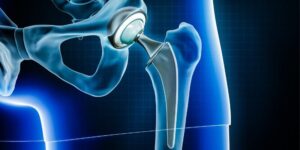
What is it?
A total hip replacement surgery, also known as total hip arthroplasty, involves replacing a damaged or worn-out hip joint with an artificial implant. The hip joint is made up of 2 surfaces: a ball and a socket. Both of these surfaces are replaced with an artificial implant. This procedure is commonly performed to relieve pain and improve function in patients with severe arthritis or hip joint damage. During the procedure the femoral head (the top of the thigh bone that makes up the “ball surface”) is removed. Then the acetabulum (hip socket or the “socket surface”) is cleaned and reshaped. A metal socket is placed in the acetabulum, often with a plastic or ceramic liner. Finally, a metal or ceramic ball is attached to a metal stem, which is inserted into the femur.
What are the signs and symptoms?
Chronic Hip Pain
- Pain in the groin, outer thigh, or buttocks
- Persistent, even at rest or during sleep
- Not relieved by medications or conservative treatments
Limited Range of Motion
- Difficulty bending, sitting, walking, or putting on shoes/socks
- Hip stiffness, especially after periods of inactivity
Limping or Altered Gait
- Limping to avoid pain (antalgic gait)
- May require use of a cane or walker
Hip Joint Stiffness
- Especially in the morning or after prolonged sitting
- Feeling that the hip is “locked” or won’t move freely
Reduced Quality of Life
- Inability to perform daily tasks or participate in activities
- Avoidance of social or physical activities due to pain or limitations
X-ray or Imaging Findings
- Bone-on-bone contact (loss of joint space)
- Osteophytes (bone spurs)
- Femoral head deformity or acetabular damage
How is it treated?
The goal of physiotherapy after a total hip replacement is to help a patient regain hip flexibility and strength. Patients may still have some pain in the hip which is due to hip stiffness and weakness. Your physiotherapist will work on stretching and massaging the muscles around the hip to help you regain your hip range of motion. Acupuncture applied on various muscles around the hip will also help relive stiffness and help reactivate function of these muscles. Your physiotherapist will prescribe a customized home exercise program focuses on stretching and strengthening your hip based on your lifestyle and athletic goals. Over the next 3-4 month your mobility will improve and your physiotherapist will create a plan with you to help you get back to all your activities such as walking, hiking, golf, etc. A total hip replacement along with the rehab that follows is highly effective at helping patients regain their full function and is often times quite life changing.
Common home exercises
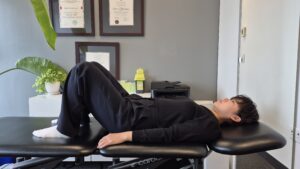
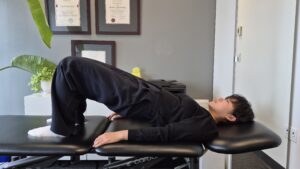
Supine Glute Bridge
This exercise helps strengthen your glutes, hamstrings, core, and lower back.
-
Lie on your back (supine position) on a mat or soft surface.
-
Bend your knees, bringing your feet flat on the floor about hip-width apart. Position your arms at your sides, palms facing down.
-
Engage your core. Squeeze your glutes and press through your heels to lift your hips off the ground.
-
Your body should form a straight line from shoulders to knees at the top.
-
Lower your hips slowly back to the floor without collapsing.
- Repeat for 12-20 repetitions and 3 sets
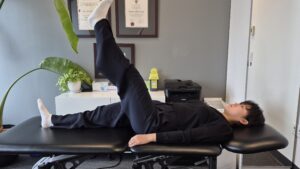
Banded Straight Leg Raise
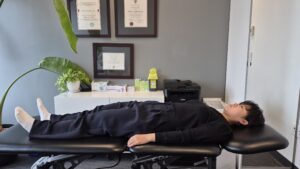
A supine straight leg raise with a band around the ankle is an excellent exercise to strengthen the hip flexors, quadriceps, and core, while promoting hip stability and control.
-
Lie on your back (supine) on a mat or firm surface, with both legs straight
-
Loop a resistance hoop around the thigh, just above the knee. (For increase resistance loop the resistance hoop around the ankle.)
-
Engage your core—keep your low back pressed gently into the mat. Keeping your knee straight, slowly lift your straight leg to about 45°–60° off the ground (roughly the height of the opposite knee).
-
Lower slowly and with control back to the floor
- Repeat for 12-20 repetitions and 3 sets
Banded Crab Walk
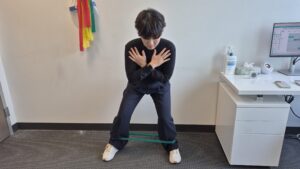
The crab walk with a band around your ankles is a great hip-strengthening exercise, especially for targeting the gluteus medius, which is essential for hip stability, knee alignment, and injury prevention.
-
Place a resistance band (loop band or mini band) around your ankles.
-
Stand with feet about hip-width apart to create light tension in the band.
-
Slightly bend your knees and push your hips back like you’re about to sit in a chair — a mini squat position.
-
Step laterally (to the side) with one foot, maintaining band tension.
-
Follow with the other foot, but don’t let your feet come too close together—this keeps constant tension on the band.
-
Take 8–10 steps in one direction, then return by stepping the opposite way. The goal is controlled, small steps, not big lunges
- Repeat for 12-20 repetitions and 3 sets

Glut Medius Leg Raises
Learn how to perform this exercise here.
Total Hip Replacement: Your Most Common Questions Answered (FAQ)
If you’ve been dealing with persistent hip pain or mobility issues, you may be wondering whether a total hip replacement is in your future. Below is a clear, patient-friendly FAQ that covers the essentials—from what the surgery involves to what recovery really looks like.
1. What is a total hip replacement?
A total hip replacement (also known as total hip arthroplasty) is a surgical procedure where a worn or damaged hip joint is removed and replaced with artificial components. The surgeon replaces:
-
The ball at the top of the femur
-
The socket in the pelvis
These new components are made of durable materials such as metal, ceramic, or high-grade plastic. The goal is to reduce pain and restore comfortable movement.
2. Why is total hip replacement done?
The surgery is typically recommended when hip pain and stiffness become severe enough to disrupt daily activities and do not improve with treatments like medication, injections, or physiotherapy.
Common reasons include:
-
Osteoarthritis
-
Rheumatoid arthritis
-
Avascular necrosis
-
Hip fractures
-
Long-standing structural issues like hip dysplasia
Ultimately, the goal is to relieve pain, improve mobility, and enhance quality of life.
3. What are the early signs that one might need a hip replacement?
Some symptoms that suggest hip degeneration may be progressing toward needing surgery include:
-
Persistent groin, thigh, or buttock pain
-
Morning stiffness or stiffness after sitting
-
Difficulty with routine tasks like putting on socks or getting in/out of a car
-
Limping or walking with reduced endurance
-
Pain that interferes with sleep
-
Reduced ability to rotate or twist the hip
-
X-rays showing significant joint damage
Having these signs does not mean surgery is required immediately, but they can be early indicators.
4. How long does rehabilitation take after a hip replacement?
Recovery is gradual and varies by individual, but typical milestones include:
1–2 weeks:
-
Walking with a walker or crutches
-
Pain and mobility steadily improving
3–6 weeks:
-
Transitioning to a cane or walking independently
-
Increasing strength, balance, and confidence
6–12 weeks:
-
Most daily activities return to normal
-
Many people resume driving or light work
3–6 months:
-
Significant gains in strength and endurance
6–12 months:
-
Full recovery for most patients
Physiotherapy plays a key role in regaining mobility and reducing stiffness.
5. Is hip replacement really life-changing?
For most people, absolutely. Hip replacement is considered one of the most effective surgeries in modern medicine. Patients often report:
-
Dramatic pain relief
-
Improved sleep
-
Increased independence
-
Ability to return to walking, exercise, and hobbies
Many patients say they wish they had done it sooner.
6. What should you expect in terms of pain and stiffness after surgery?
Pain:
-
Pain varies from patient to patient. Most patients report very little discomfort and for patients that reports discomfort it tends to be the most intense the first few days
-
Dramatically improves over 2–3 weeks
-
Mild soreness may continue for several months as strength returns
Stiffness:
-
Common early due to swelling
-
Improves steadily with walking and physiotherapy
-
Usually much better by 6–12 weeks
Normal temporary symptoms may include:
-
Swelling or bruising
-
Numbness near the incision
-
Clicking sounds from the artificial joint
If pain suddenly worsens, or you notice fever, redness, or drainage, contact your surgeon.