A wrist sprain or strain is a common injury that can happen during sports, daily activities, or even a simple fall. Because we rely on our wrists for almost every hand movement, even a mild injury can make everyday tasks uncomfortable. Understanding what a wrist sprain or strain is, how it occurs, and how to recover properly can help you protect your wrist, reduce pain, and return to your normal activities with confidence.

What is it?
A wrist sprain or strain refers to an injury affecting the soft tissues of the wrist, but each involves different structures:
Wrist Sprain
A sprain happens when the ligaments—the tough bands of tissue connecting bone to bone—are stretched or torn.
Sprains usually occur from sudden force, like falling on an outstretched hand, twisting the wrist during sports, or overstretching the joint. The severity can range from mild stretching to partial or complete ligament tears.
Wrist Strain
A strain affects the muscles or tendons—the tissues that help move the wrist.
Strains happen through overuse (like repetitive typing or lifting), sudden overstretching, or forceful pulling of the muscles and tendons.
What are the signs and symptoms?
Typical Symptoms of Both
- Pain with movement or gripping
- Swelling around the wrist
- Tenderness to touch
- Reduced strength or range of motion
- Bruising (more common in sprains)
How is it treated?
Treatment for both a wrist sprain/strain focuses on reducing pain and increasing mobility and strength in the wrist. Depending on the nature of the wrist sprain/strain your physiotherapist may recommend a wrist brace for you to wear temporary to provide some stability and protection for the wrist. Your physiotherapist will massage the muscles and ligaments around the wrist to improve wrist flexibility. Joint mobilizations will be preformed by your physiotherapist to gently stretch the specific ligaments that you injured to help that ligament heal properly and regain its natural elasticity. Your physiotherapist will provide exercises to strengthen your wrist in order to restore wrist stability. You and your physiotherapist will discuss your sporting activities and current training routine to determine which activities you may need to temporarily scale back in order to give your wrist adequate rest, as well as when it will be safe to return to full activity. Our goal is to keep you as active as possible during your recovery.
Common home exercises
Wrist Circles
The purpose of this exercise is to increase wrist mobility.
- Sit or stand comfortably with your elbow bent and tucked close to your side.
- Hold your hand out in front of you with your wrist relaxed.
- Slowly begin moving your hand in a circular motion, creating smooth, controlled circles.
- Make 10 circles clockwise, keeping the motion as pain-free as possible.
- Reverse the direction and make 10 circles counter-clockwise.
- Keep your forearm still—only the wrist and hand should be moving.
- Repeat 3 sets as tolerated.

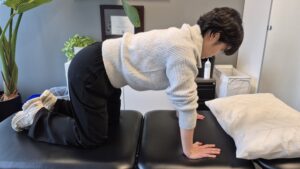
4 Point Kneel
The purpose of this exercise is to reintroduce a weight bearing exercise back to the wrist.
-
Start on the floor on your hands and knees.
-
Place your hands directly under your shoulders and your knees directly under your hips.
-
Keep your back flat and neutral—avoid arching or rounding.
-
Look down at the floor so your neck stays aligned with your spine.
-
Hold this position while breathing steadily for 10–30 seconds
- You can make this exercise more difficult by moving your knees further back behind your hips or perform this exercise from your toes.
Pinch Gripping
Learn how to preform this exercise here.