
Ankle pain that persists long after an ankle sprain or develops gradually during sports isn’t always caused by a ligament injury. One common but often overlooked condition is ankle impingement.
Ankle impingement occurs when soft tissue or bone at the front or back of the ankle becomes pinched during movement. This can lead to pain, stiffness, swelling, and reduced mobility, making activities like walking, running, squatting, or climbing stairs uncomfortable.
The good news is that most cases respond very well to physiotherapy when identified early.

What Is Ankle Impingement?
Ankle impingement is a condition where structures inside the ankle joint become compressed during movement. This repeated pinching causes inflammation, pain, and restricted motion.
There are two primary types:
Anterior ankle impingement (front of the ankle)
This is the most common form and typically causes pain when bending the ankle upward (dorsiflexion). It often develops after repeated ankle sprains or from sports that involve frequent jumping, sprinting, or squatting.
Posterior ankle impingement (back of the ankle)
Pain occurs at the back of the ankle when pointing the toes downward (plantarflexion). This condition is commonly seen in ballet dancers, soccer players, gymnasts, and swimmers.
Common Symptoms
Symptoms of ankle impingement often develop gradually but can also begin after an ankle injury.
Common signs include:
- Pain at the front or back of the ankle during movement
- Pain when squatting, climbing stairs, or running
- Stiffness, especially first thing in the morning
- Reduced ankle flexibility
- Swelling around the joint
- A feeling of the ankle “blocking” or getting stuck
- Difficulty returning to sports after an ankle sprain
Many people notice that the ankle feels stable but simply doesn’t move as freely as it used to.
What Causes Ankle Impingement?
Several factors can contribute to ankle impingement.
Previous Ankle Sprains
Repeated ankle sprains are the leading cause. After a sprain, scar tissue can build up inside the joint, becoming pinched whenever the ankle moves.
Bone Spurs
Over time, repetitive stress can cause small bone spurs to develop at the front or back of the ankle. These extra pieces of bone reduce joint space and create mechanical pinching.
Repetitive Sports
Sports involving repeated jumping, kicking, sprinting, or deep squatting place significant stress on the ankle.
Common sports include:
- Soccer
- Basketball
- Volleyball
- Ballet
- Running
- Tennis
- CrossFit
Limited Ankle Mobility
Restricted movement in the ankle joint changes normal mechanics, increasing compression during movement.
Poor Movement Patterns
Weakness in the calf muscles, hips, or foot muscles can alter how forces travel through the ankle, increasing irritation over time.
Who Is Most at Risk?
You may have a higher chance of developing ankle impingement if you:
- Have had one or more ankle sprains
- Participate in sports involving jumping or quick direction changes
- Frequently squat or lift weights
- Have limited ankle flexibility
- Experience chronic ankle stiffness
- Continue exercising through ongoing ankle pain
How Is Ankle Impingement Diagnosed?
A physiotherapist will begin with a thorough assessment, including:
- Reviewing your injury history
- Assessing ankle range of motion
- Identifying movements that reproduce symptoms
- Evaluating walking, running, squatting, and balance
- Testing ankle strength and stability
If a bone spur or significant structural issue is suspected, your healthcare provider may recommend imaging such as an X-ray or MRI.
Physiotherapy Treatment
Physiotherapy is often the first line of treatment and can significantly reduce pain while restoring normal ankle movement. Based on the results of a thorough assessment, a comprehensive treatment plan will be developed. Joint mobilizations will be used to help improve joint mobility and reduce stiffness within the ankle. Soft tissue treatment of tight muscles including the calves, tibialis anterior and surrounding tissues can also decrease stress on the ankle joint. Mobility exercises will be used to restore normal dorsiflexion, which is often one of the most important goals during rehabilitation.
Exercise will be focused on improving strength throughout the foot, ankle, calf, and hips to reduce excessive stress on the joint.
Balance and Proprioception Training
Following an ankle sprain, the body’s ability to sense joint position is often reduced. Balance training improves stability and helps prevent future injuries.
Return-to-Sport Progression
Your physiotherapist will gradually progress exercises toward running, jumping, cutting, and sport-specific drills once pain has improved.
Exercises for Ankle Impingement
These exercises are commonly prescribed during rehabilitation. They should only be performed if they do not significantly increase pain.
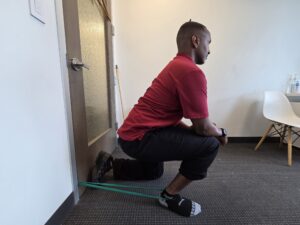
1. Banded dorsiflexion mobilization
Tie a band to a stable object and loop the band around the front of the ankle. Keeping your heel on the floor, slowly bend your knee forward over the ankle joint.
Repeat for 10–15 repetitions.
2. Heel Raises
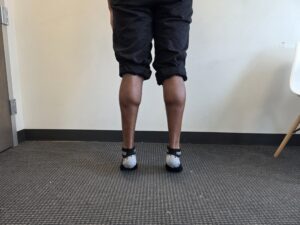
Stand on both feet and slowly rise onto your toes.
Lower under control.
Progress to single-leg heel raises as symptoms improve.
Perform 3 sets of 10–15 repetitions.
3. Single-Leg Balance
Stand on one leg for 30–60 seconds.
Progress by closing your eyes or standing on an unstable surface.
Repeat 3 times.
4. Resistance Band Ankle Strengthening
Use a resistance band to strengthen:
- Dorsiflexion
- Plantarflexion
- Inversion
- Eversion
Perform 2–3 sets of 15 repetitions.
How Rebuild Physiotherapy Can Help
At Rebuild Physiotherapy, our physiotherapists perform a detailed assessment to identify the underlying cause of your ankle pain rather than simply treating the symptoms.
Your treatment plan may include hands-on manual therapy, mobility exercises, progressive strengthening, balance training, and sport-specific rehabilitation designed to restore pain-free movement and help prevent future injuries.
Whether your ankle pain started after a recent sprain or has gradually developed over months of activity, early physiotherapy can help you recover faster and return to the activities you enjoy with confidence.
Frequently Asked Questions About Ankle Impingement
1. What is ankle impingement?
Ankle impingement is a condition where soft tissue or bone becomes pinched inside the ankle joint during movement. This can cause pain, stiffness, swelling, and limited range of motion. It commonly develops after repeated ankle sprains or from sports that involve jumping, running, or squatting.
2. What are the symptoms of ankle impingement?
Common symptoms include pain at the front or back of the ankle, stiffness, swelling, reduced ankle flexibility, pain when squatting or climbing stairs, and a feeling that the ankle gets “stuck” or blocked during movement.
3. Can ankle impingement heal on its own?
Mild cases may improve with rest and activity modification, but persistent ankle impingement often requires physiotherapy. Without treatment, ongoing inflammation and restricted movement may continue to limit daily activities and sports participation.
4. What causes ankle impingement?
The most common causes include previous ankle sprains, scar tissue formation, bone spurs, repetitive sports activities, limited ankle mobility, and muscle weakness that changes how the ankle moves.
5. How is ankle impingement diagnosed?
A physiotherapist diagnoses ankle impingement through a detailed physical examination, including testing ankle movement, strength, flexibility, and the positions that reproduce your pain. In some cases, an X-ray or MRI may be recommended to identify bone spurs or other structural problems.
6. Can I continue exercising with ankle impingement?
It depends on your symptoms. Activities that cause significant pain should be modified or temporarily avoided. Your physiotherapist can recommend alternative exercises that maintain your fitness while allowing the ankle to recover.
7. What is the best treatment for ankle impingement?
Physiotherapy is usually the first treatment recommended. Treatment may include manual therapy, joint mobilization, soft tissue treatment, mobility exercises, strengthening, balance training, and a gradual return-to-sport program. Most people improve without surgery.
8. How long does it take to recover from ankle impingement?
Recovery depends on the severity of the condition and how long symptoms have been present. Many people notice improvement within 5-6 weeks of consistent physiotherapy, although more chronic cases may require a longer rehabilitation program.
9. Will I need surgery for ankle impingement?
Most people do not require surgery. Conservative treatment with physiotherapy is successful for many cases. Surgery is generally considered only if symptoms persist despite several months of appropriate rehabilitation or if large bone spurs are causing mechanical blockage.
10. Can ankle impingement come back?
Yes. If the underlying causes—such as poor ankle mobility, muscle weakness, or returning to sport too quickly—are not addressed, ankle impingement can recur. Completing a full rehabilitation program and continuing strengthening and mobility exercises can significantly reduce the risk of recurrence.